Playbooks
Using Eligibility Gates to Keep Bots and Airdrop Farmers Out of Your Campaign

Why bots and farmers drain your reward pool
You fund a campaign, the tasks go live, and within hours the completions roll in. The problem is who completed them. If your reward pool is open to anyone, a large share of it can leak to bot accounts and airdrop farmers — empty profiles that claim, never engage, and disappear. The follower count ticks up, but the audience isn't real and the spend isn't recoverable.
The fix isn't policing every submission after the fact. It's deciding up front who is even allowed to participate. On Dopamyn, that decision lives in your eligibility gates — the rules you set on a quest before it goes live. Get them right and you don't have to filter bots from a crypto campaign reactively, because the bots never qualified in the first place.
This playbook walks through the gates available today, how to combine them, and how verification backs them up so your USDC reaches real, active accounts.
How to filter bots from a crypto campaign with eligibility gates
When you create a quest on Dopamyn — a follow, retweet, reply, quote-tweet, or a bundle of task types — you set a reward pool in USDC, decide how many participants you want, and then gate who qualifies. These are the gates you can apply:
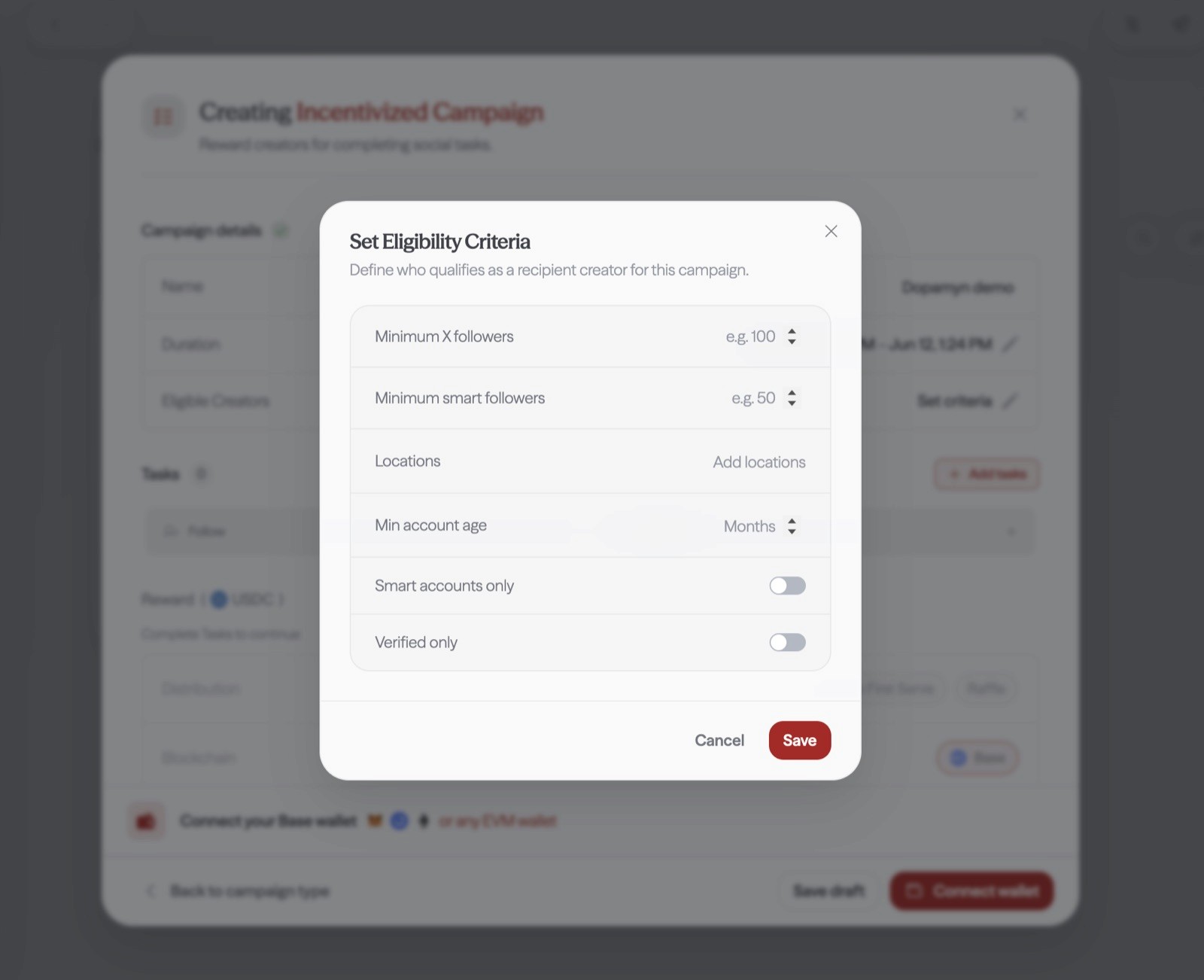
Minimum followers
Set a min_followers threshold so only accounts above a certain size can participate — for example, only accounts with 1,000+ followers. This is your coarsest filter. It won't catch every bot (some inflate follower counts), but it removes the floor of empty, zero-reach accounts in one move.
Smart followers
Raw follower count is gameable; smart followers are harder to fake. The min_smart_followers gate restricts participation to accounts that have a minimum number of real, active followers — for example, 500+ smart followers. An account with 50,000 bought followers and 12 smart followers won't clear this bar. If you only set one quality gate, this is usually the one that does the most work.
Verified-only
The is_verified_account gate limits participation to X-verified accounts. When a founder asks for "verified followers," the honest version of that is a follow quest gated to verified accounts, with each follow verified before payout — not a purchased package. Pair it with a smart-follower threshold and you've narrowed to accounts that are both verified and have a genuine audience.
Smart accounts
The is_smart_account gate restricts participation to accounts flagged as high-quality. This is a reputation signal on the account itself, complementary to the smart-followers count: one rates the account, the other rates its audience.
Account age
Newly created accounts are a classic farming pattern — spin up, claim, abandon. An account-age threshold filters out accounts created below a minimum age, cutting off the freshest throwaway profiles before they reach your pool.
Curated lists
Sometimes you don't want "anyone who meets a bar" — you want specific people. A curated KOL list restricts participation to handles you choose. Use it when you've already identified the right creators for your niche and want the reward pool reserved exclusively for them.
Layer the gates — don't rely on one
The gates compound. A single threshold is a sieve with big holes; stacking them tightens the mesh. A practical combination for a quality follow quest might be:
min_followersat a sensible floor (e.g. 1,000+)min_smart_followersto ensure a real audience (e.g. 500+)An account-age threshold to drop throwaway accounts
is_verified_accountif you want an extra credibility signal
The same filters apply to engagement quests — retweet, reply, quote-tweet — not just follows. So when you generate social proof around an announcement, testnet, or token event, the accounts amplifying you clear the same quality bar.
These gates also work across task bundles. You can combine task types in one quest — "follow + retweet + reply" — and the eligibility rules apply to the whole bundle. Building a Telegram community? A Telegram-join task carries the same eligibility filters, and a Telegram bot confirms the user actually joined and stayed, so you're not paying farmers who leave the moment they claim.
Gates decide eligibility — verification confirms the work
Eligibility gates control who can participate. They don't, on their own, confirm that the work was genuinely done. That's the job of the verification pipeline, and the two layers together are what make the spend trustworthy.
Every task completion is independently verified before any payout triggers:
X tasks (follow, like, retweet, tweet, reply, quote-tweet) are checked against the platform before payout.
Telegram joins are confirmed by the Dopamyn bot.
Content quality — replies, quote tweets, and custom submissions — is checked by AI for substance. Participants who paste generic text, gibberish, or spam get rejected even if they passed the eligibility gates.
Custom tasks use screenshot or file-upload proof, reviewed manually or by AI.
Only after verification passes does the reward get issued on-chain. Because the reward pool is held in escrow in an on-chain contract until verification clears, you pay per verified action — not per claim, and not per unverifiable impression. There's also a fraud-detection layer that scans task completions for fraud signals and can block flagged users from participating.
The result: gates keep low-quality accounts out before they start, and verification ensures the ones who do participate actually did the work.
A quick mental model
When you set up a campaign, ask two questions in order:
Who deserves to be in my pool? Set your eligibility gates — followers, smart followers, verified, smart account, account age, or a curated list.
How do I know the work was real? Lean on the verification pipeline and on-chain escrow, which run automatically.
Answer the first well and you've already filtered most bots from your crypto campaign. Answer both and your USDC reaches real, active accounts every time.
Across 320+ campaigns from 190+ founders, with $16.3K in rewards distributed on-chain, the pattern holds: the campaigns that perform are the ones with the right gates set from the start.
Ready to run one? Set your eligibility gates and fund a quest on Dopamyn — see how it works for projects, or read the full guide to running a Web3 KOL campaign.